
Class Politics Without Enemies?
News and Views from the Center for Working-Class Politics: March 6, 2026
Third Way has some interesting (and some misleading) new data about Democratic Primary voters. A new paper looks at the gentrification of the Democratic Party. Economist Joseph Stiglitz warns of the blue-collar job dearth. James Talarico proves the potency of a class message. And firefighter Bob Brooks looks to do the same.
Plus, mark your calendars: CWCP board member Matt Karp will be in NYC with Breaking Points host Krystal Ball on April 4, 2026
Below you’ll find a range of news and views that concern working-class politics. Many are written by research associates and friends of the Center for Working-Class Politics.
Finally, our newest report,“Unions and Politics: Can Union Candidates Make a Difference?”, will be out soon. If you want to be among the first to receive it subscribe today.
The Truth About Democratic Primary Voters
Third Way has a new memo out on the political attitudes of Democratic Primary voters that’s worth reading. Of course, the authors couldn’t help but try to shoehorn their own angle and editorializing into the results. Take this question:
We also asked a forced choice question designed to test two theories of the case for how to be a fighter:
53% preferred a candidate will fight every day for the working people of this country, delivering a safer, stronger, and more affordable future.
47% picked a candidate who believes that billionaires and corporate interests have too much power in this country and will fight the oligarchy and go after corporations that have rigged the system.
The first thing to notice is that the difference is actually pretty small, but worse than that, the question design is awfully loaded. The first option includes the words “working people,” “safer,” and “affordable” while the second option only refers to what a candidate might fight against. They’re putting their finger on the scales. They want candidates to ‘fight for the working class’ without ‘fighting against the billionaires.’
Trouble is, that’s bad politics. Worse, it’s an impossible economic program.
As we’ve shown (again and again and again) going after the elite is popular. It is especially popular among the working-class, and independent, voters Democrats desperately need to win. And the reason it’s good politics is because it’s good policy.
The truth is our “K-shaped” economy just isn’t producing high-wage jobs. Those with assets rise while those with nothing but labor to sell get crushed. Scrapping tariffs, as so many Democrats are giddy to do, won’t change that. The “knowledge economy” era of free-trade and globalization (inaugurated by Clinton, and endorsed all the way by Third Way) has produced flat or declining wages for those without a college-degree. Meanwhile, it has generated fabulous wealth for those at the top. Now, with tech billionaires boasting about AI-induced white-collar layoffs, we could see the same wage-stagnation among the college-educated set. All the talk of “affordability” and “abundance” won’t get very far unless we can figure out something to do about all this.
And what needs to be done is more than just regulatory policies that “encourage growth.” Growth alone, as we’ve seen, just rewards the rich as wealth gets siphoned upwards to the top. What we really need is to induce investment, on a large scale, particularly in public works. This was the whole point of the Keynesian revolution but it’s somehow been forgotten—so much so that Third Way didn’t include one question about infrastructure spending. That’s maddening.
Instead, the authors argue that primary voters “don’t want their nominee to go so far left in a primary that they can’t win against MAGA.” Leaving aside the fact that they don’t differentiate between going “too far Left” on social and cultural issues (versus going populist on economics), the problem with this framing is that it overlooks the ways in which a sprint away from the Left can make Third Way Democrats less, not more, electable.
Take San Francisco DA Brooke Jenkins who, at a Third Way event, finds grievance, not with her city’s dizzying combination of disorder, drug crisis, and decadence but with “the labor unions…collecting signatures for a wealth tax.” She goes on to praise the billionaires in her city (most in the country!) and how charitable they are (unlike those greedy bus drivers). Are you kidding?
Here you have a caricature of the coastal liberal. In her bid to play the part of hard-nosed political realist, she attacks the one institutional group attached to the Democratic Party that could possibly give her a glimpse into what ordinary people think and feel.
Elites moved toward Democrats more than nonelites moved away
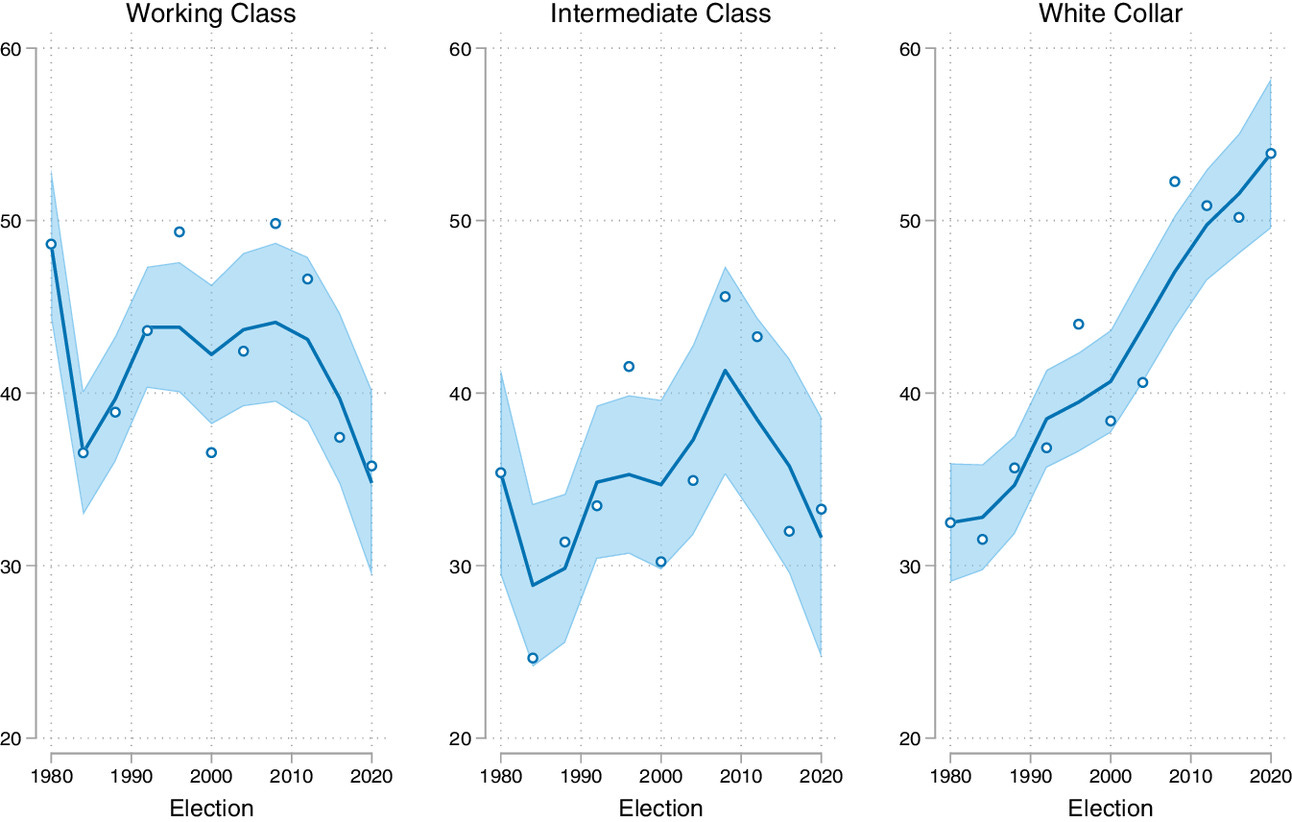
Sociologists Karyn Vilbig and Paula England have a new paper out that shows that elites moved into the Democratic Party in both larger numbers, and at a more steady rate, than working-class voters moved out. Their paper also has the benefit of measuring class by income, education, and occupation (just like we do).
Here are the trends using occupation-based class definitions:1
Among working-class White voters, Democratic support decreased from 47% in 2012 to 37% in Trump’s first election and 36% in the 2020 election. Among White voters in the intermediate class, Democratic support dropped from 43% in the 2012 presidential election to 32% and 33% in the 2016 and 2020 elections, respectively. This recent low for both the working and intermediate classes is similar to previous low points of Democratic support in the 1984 and 2000 elections. However, while Fig. 3 does show the working class turning toward Trump between 2012 and 2020, it also makes clear that the working class has not been moving away from Democrats consistently, but fluctuated up and down between 1980 and 2012 without a clear pattern.
The authors may understate the evidence for a secular decline in working-class Democratic voters, but they do point out an important pattern here (or rather lack of pattern). If you look at the trends below it’s clear that the candidate and campaign really matter for winning working-class voters. Get the right program and leader and you can win back a lot of voters:
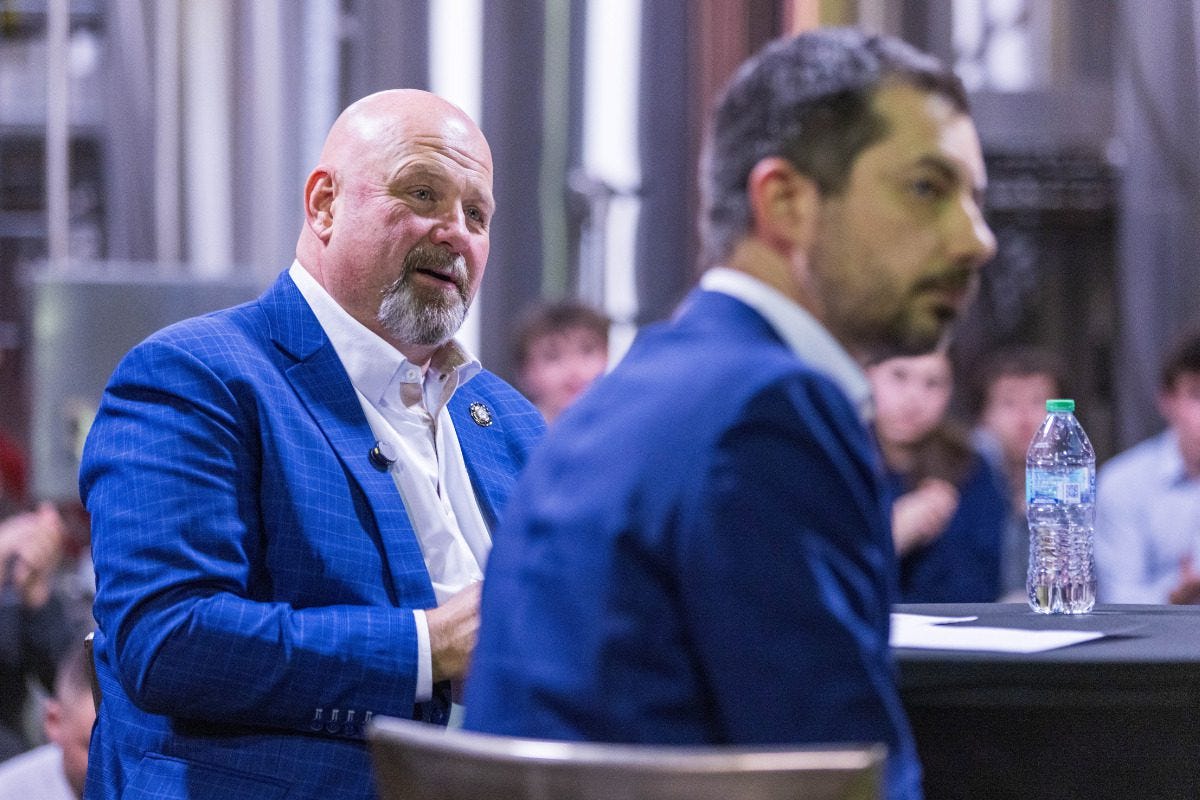
A working-class candidate: Bob Brooks sets progressive agenda
Brooks has a crowded primary to get through but he’s got the stuff:
Bob Brooks, a former 20-year firefighter for the City of Bethlehem and current President of the Pennsylvania Professional Fire Fighters Association, laid out a bold, progressive agenda for his congressional campaign in front of hundreds of supporters in Easton on Monday. “Here’s a little of what I’d like to do down there. I want to restore health care cuts Ryan Mackenzie voted for. I would like to institute universal health care,” Brooks said, adding, “I want to make the ultra-wealthy pay their fair share. No more billionaires paying the same or less than a nurse or a teacher.” … “ Only 2% of Congress comes from the working class, yet 60% of the United States comes from the working class. I consider myself part of the 60%,” Brooks told the crowd.
I think we can take a little bit of credit for popularizing that 2% statistic. It’s a powerful demonstration of how lopsided Congress (and its interests) tend to be. More candidates should point this out.
Nobel economist warns a dearth of blue-collar jobs is among the biggest threats to the U.S.
Joseph Stiglitz, a Keynesian economist at Columbia, was sounding the alarm about the decline of manufacturing:
In a criticism of President Donald Trump’s economic policies, Stiglitz said one of the greatest threats to the precarious health of the U.S. economy was slumping blue-collar jobs, including a scarcity of manufacturing roles.
“Do you know what happened to jobs in manufacturing in the last year? They’re down,” he said. “[Trump] didn’t succeed over the last year in bringing back manufacturing jobs.”
James Talarico’s Win Shows the Promise of a Class Message
Talarico cleaned up in his bid to become the Democratic nominee for US Senate in Texas. David Griscom has a good write up on how his sticking to the economic populism helped:
The Texas Senate race has been fiery and divisive. You could be forgiven for imagining there is a massive difference in platforms between Talarico and his opponent, Congresswoman Jasmine Crockett. In fact, rather than the policy battles that dominated the 2020 Democratic presidential primary, this race has been a lot more about style over substance. But in this case, the style matters. Talarico infused his Christianity with an economic populist message. “We already have class warfare in this country. It’s the billionaires waging war against the rest of us,” Talarico told a voter at a town hall. His ability to tap into this populist anger, no doubt, explains one key aspect of his victory; Talarico racked up huge margins in counties that Bernie Sanders won in the 2020 Texas primary.
Britain’s class politics is back—with a Green twist
The Economist has an interesting review of the rise of Right and Left populisms in Britain and how they threaten the established parties. Though the headline is a bit misleading. Their own data show that Nigel Farage’s Reform UK are currently winning the working class:
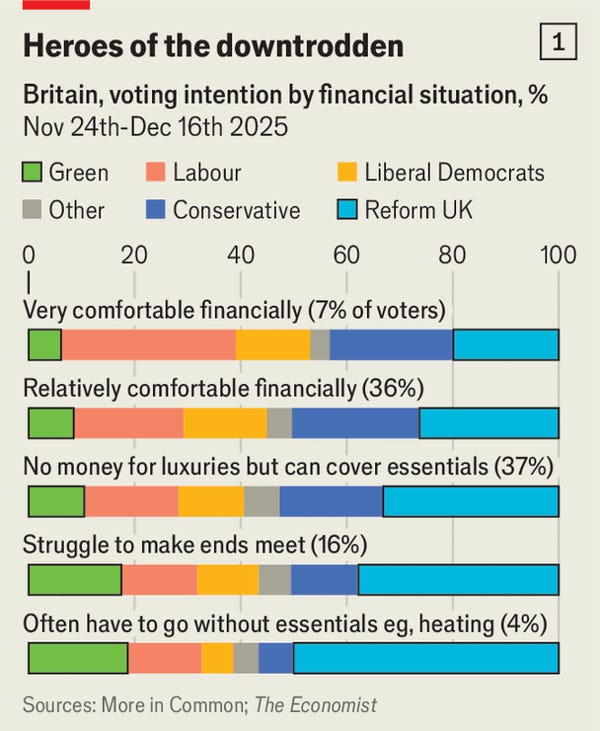
At the same time working-class candidates, armed with a full-throated populist program, can pull against the tide:
A by-election in Greater Manchester on February 26th illustrated Britain’s new politics. Support for the Greens surged from 13% to 41% in Gorton and Denton, a former safe Labour seat that is the 15th-most deprived constituency in England (out of 543). “Looking at the future, how are we supposed to afford houses, cars? We can’t afford to do food shopping sometimes,” says Katie, a former Labour voter. She voted for Hannah Spencer, a charismatic and class-conscious Green who gave up her job as a plumber to become the party’s first MP in the north of England.
Reform pushed Labour into third place. “I had a decent job, I’m on [a] pittance now,” says Jamie, who is a full-time carer for his wife. “We need someone to put it right, so I say give Nigel and Reform a chance.” It is a common refrain from voters who feel that they have little to lose.
NYC Event: Who Speaks for the Working-Class Majority?
Get your tickets now for a live event featuring the host of Breaking Points Krystal Ball, NYU sociologist Vivek Chibber, and Princeton University historian (and CWCP board member) Matt Karp for a live event on how class politics can convert popular anger into durable power — and why rebuilding labor is the precondition for any serious democratic renewal.
The discussion will be moderated by Melissa Naschek.
Closing Note: Class and status explained…
According to the authors: “We follow Morgan and Lee’s (24) system of class categorization which uses occupation to assign individuals to the working class, an intermediate class, and a white-collar class.† The working-class category includes manual workers (e.g. roofers, dishwashers) and service workers of a lower grade (e.g. cashiers, bus drivers, mail clerks). The intermediate class includes nonprofessional self-employed workers, higher-grade technicians (e.g. clinical laboratory technicians), and supervisors of manual workers (e.g. construction supervisors). The white-collar class includes professionals and managers (e.g. lawyers, computer programmers, registered nurses, elementary and middle school teachers) and routine nonmanual and service employees of a higher grade (e.g. flight attendants, tax preparers, secretaries).”
I was gonna comment on the Trump abandonment article, but you won't let me. Oh well.
As long as your side keeps nominating compleat losers, we'll stick to our strategy: no to psychopathic Clinton. No to cackling Harris. No to gruesom Newsom. Who else you got?
I think Vilbig and England are slicing and dicing a little too much looking for the results they want. Ever heard of a mail clerk in this century? Secretary? Is that like with typewriters and taking dictation? RNs in the professional class? They call themselves BSNs for a reason. RNs are one of the few blue collar jobs that pay decently, and like floor hands on a drill rig they work for their money.
Third Way loses me at "working people". It's been so long since most elites have known anyone actually in the working class that all they know how to do is b**ch about the bill the electrician hands them. Or denigrate someone in a pick up with lifters.
The Democratic Party has lost the working class since Obama. We should be looking at our policies, not our demographics. Our policies have messed over the working class, time to stop.